
Cognitive Dissonance: Learning to Be Who You Want to Be
Acknowledging the Universal Contradiction in Our Actions - Even (and Especially) When It's Hard


In the endeavor for deep self-realization and life optimization, we often find ourselves baffled by moments of internal conflict - times when our intentions don’t align with our values. Maybe, it’s driving to the gym with every intention of exercising and then never stepping inside. Or maybe, sitting in your living room, surrounded by a mountain of tasks, but still choosing to binge-watch your favorite show. Perhaps, for you, it’s the endless scrolling on your phone when you promised yourself just a quick check.
Some more relatable scenarios (as if, you need them):
Workplace distractions: Intending to focus on a project but repeatedly checking email or messaging apps.
Health and wellness decisions: Snacking a meal away on your favorite sweet, salty, or fried food/drink even when you’ve planned a balanced nutrition plan for dinner.
Social interactions: Saying “yes” to events you don’t want to attend, thus creating that uncomfortable friction between social obligation and time spent on your true values.
These moments reflect a deep and universal tension, arising from the clash between our actions and our beliefs, offering insight into the nature of a moral compass and our ability to act in alignment with our values. “Seeing through” the defenses of our own minds allows us to recognize where our actions diverge from our highest intentions, giving us the insight needed to detect, intervene, and enhance our behavior across every area of life, from health and focus to relationships and moral growth.
I want to examine with you a strategic window into the workings of consciousness and our drive and capacity for self-directed growth.
These everyday mental conflicts are the signals of a universal psychological phenomenon that psychologists call “cognitive dissonance.” Understanding it helps us see, not only why we self-sabotage and act against our best intentions, but also, and perhaps more importantly, how the mind can restore harmony between belief and behavior.
Let’s explore what cognitive dissonance is, how it manifests in the brain and mind, and how understanding it can help us in our quest for moral enlightenment and lifetime optimization.
Mechanisms: How the Brain and Mind Register the Knot

The brain tracks internal contradictions in fascinating ways, using the same circuitry for errors and learning to navigate moments when behavior conflicts with values.
Key mechanisms include:
Conflict detection: Neuroimaging research has consistently identified the dorsal anterior cingulate cortex (dACC) and anterior insula as the primary regions involved in detecting cognitive conflicts. In a landmark 2009 study, van Veen and colleagues demonstrated that activation in these regions during counter-attitudinal advocacy could predict subsequent attitude change (van Veen et al., 2009).
The dACC essentially serves as an internal alarm system, signaling when our actions contradict our beliefs.
Choice and value coding: After making difficult decisions, our brains actually “rebake” our preferences to align with our chosen actions. Research by Izuma and colleagues (2010) showed that value signals in the striatum and prefrontal cortex shift following hard choices, essentially updating our internal value system to justify what we’ve already decided.
Electrophysiology and timing: Using EEG technology, Colosio and colleagues (2017) discovered that cognitive dissonance triggers an error-related signal in the brain within just 46-60 milliseconds after making a conflicting decision. This “error” signal appears at frontocentral electrode sites, suggesting the same monitoring systems that detect mistakes also track internal contradictions.
What This Means: you can feel, even if just for a brief moment, when your actions are contradicting your beliefs—this is an excellent way to find “the pause” during which you can choose differently.
Someone once proposed to me, upon my beseeching moral guidance from them: “Just stop for one moment and ask yourself if it feels right or wrong—you already know.”
The same neural machinery that notices you’ve misspelled a word also flares when your actions misspell your values.
Modern Theoretical Framings: Predictive Processing and Beyond

Cognitive dissonance can be understood through the lens of predictive processing—a revolutionary framework championed by neuroscientist Anil Seth that explains how our brains constantly generate predictions about the world and update them based on incoming information.
Predictive-dissonance bridge: According to Seth’s theory of consciousness as a “controlled hallucination,” our brains are constantly creating predictions about reality, including predictions about ourselves (Seth, 2021). When we act against our values, we create what Kaaronen (2018) calls “predictive dissonance”—a high-level prediction error that the brain must resolve.
Just as the brain updates its model when sensory input contradicts expectations, it must update either beliefs or behaviors when they contradict each other.
Dr. Seth’s interoceptive inference model suggests that emotions, including the discomfort of dissonance, arise from the brain’s predictions about internal bodily states. The anterior insula, which is heavily activated during dissonance, is a key hub for processing these internal signals, creating the visceral discomfort we feel when our actions betray our values.
How knowing this helps: this discomfort is the subjective texture of a predictive system rewriting itself; dissonance exposes how beliefs act as simulations of future coherence, constantly being tested and revised. Selfhood becomes a living model that updates when experience contradicts expectation.
Appraisal and emotion regulation: Cascio and colleagues (2016) demonstrated that dissonance can be understood as a threat to self-integrity that prompts various coping strategies—reframing the situation, justifying the behavior, or affirming core values in other domains.
Their neuroimaging work showed that self-affirmation activates reward-related brain regions (ventral striatum, ventromedial prefrontal cortex), essentially buffering against the threat of inconsistency.
Behavioral and Clinical Consequences—Where Science Has Tested Interventions
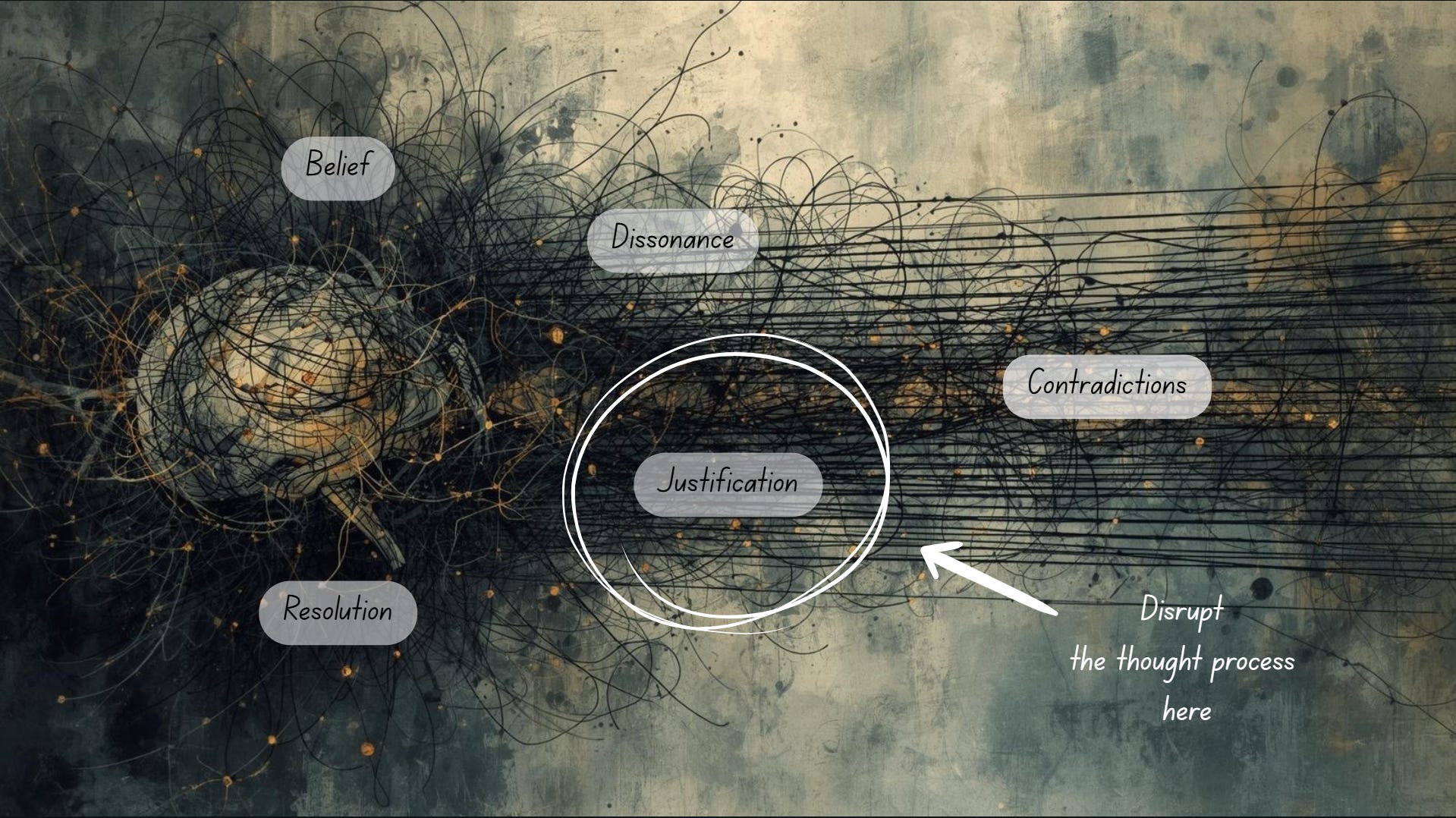
The experience of cognitive dissonance offers profound insights into the nature of consciousness and identity. Rather than revealing a fixed, unchanging self, these moments of internal conflict illuminate how our sense of who we are emerges from an ongoing dialogue between our actions, beliefs, and the stories we tell ourselves.
Behavior change via dissonance: A systematic review by Freijy & Kothe (2013) examining health behavior interventions found that inducing mild dissonance can effectively shift behaviors across domains like smoking cessation, safe sex practices, and healthy eating.
The key is creating just enough inconsistency to motivate change without triggering defensive reactions.
Self-affirmation as buffer: Reflecting on core values before encountering threatening information dampens defensiveness and activates reward-related brain regions. This neural buffering effect explains why affirmation exercises can help people accept difficult health messages or feedback about their behavior without becoming defensive.
Group and vicarious effects: 🌟A recent meta-analysis by Jaubert and colleagues (2024) revealed that we can experience “vicarious dissonance” when observing in-group members act inconsistently. This social transmission of dissonance helps explain why we become like those we spend time with—their internal conflicts become our own.
Phenomenology and Philosophy: What Dissonance Reveals About Selfhood

The self as process: Dissonance shows that the self is not a thing but a negotiation. When action contradicts self-concept, the mind either:
updates the self
reinterprets the action and/or
adjusts surrounding beliefs to preserve identity
Moral friction and growth: Painful dissonance can become moral learning when attended to rather than suppressed.
Limits and illusions: Because dissonance reduction often involves rationalization, it explains moral blind spots and self-deception, revealing both the resilience and fragility of consciousness.
Closing Reflection—Consciousness in the Tension

Dissonance is the evidence of consciousness doing its job. It’s how a self-aware system detects inconsistency and adjusts its internal map of reality.
Dissonance as signal, not failure: Marks the boundary between what was once true and what is becoming true.
Ethical stance: Respond gently—not every inconsistency is hypocrisy. Some are growing pains.
For contemplative inquiry: Feeling pulled between belief and behavior is an invitation to witness awareness itself at work, itself a live thread of consciousness reweaving coherence.
When dissonance hurts, the mind is learning to tell the truth more precisely.
References
Cascio, C. N., O’Donnell, M. B., Tinney, F. J., Lieberman, M. D., Taylor, S. E., Strecher, V. J., & Falk, E. B. (2016). Self-affirmation activates brain systems associated with self-related processing and reward and is reinforced by future orientation. Social Cognitive and Affective Neuroscience, 11(4), 621–629. https://doi.org/10.1093/scan/nsv136
Colosio, M., Shestakova, A., Nikulin, V. V., Blagovechtchenski, E., & Klucharev, V. (2017). Neural mechanisms of cognitive dissonance (revised): An EEG study. The Journal of Neuroscience, 37(20), 5074–5083. https://doi.org/10.1523/JNEUROSCI.3209-16.2017
Freijy, T., & Kothe, E. J. (2013). Dissonance-based interventions for health behaviour change: A systematic review. British Journal of Health Psychology, 18(2), 310–337. https://doi.org/10.1111/bjhp.12035
Izuma, K., Matsumoto, M., Murayama, K., Samejima, K., Sadato, N., & Matsumoto, K. (2010). Neural correlates of cognitive dissonance and choice-induced preference change. Proceedings of the National Academy of Sciences, 107(51), 22014–22019. https://doi.org/10.1073/pnas.1011879108
Jaubert, S., Fillon, A. A., Souchet, L., & Girandola, F. (2024). Vicarious dissonance: Pre-registered meta-analysis. Personality and Social Psychology Bulletin, 50(1), 45-62. https://doi.org/10.1177/01461672241266653
Kaaronen, R. O. (2018). A theory of predictive dissonance: Predictive processing presents a new take on cognitive dissonance. Frontiers in Psychology, 9, 2218. https://doi.org/10.3389/fpsyg.2018.02218
Seth, A. (2021). Being you: A new science of consciousness. Dutton.
Seth, A. K. (2013). Interoceptive inference, emotion, and the embodied self. Trends in Cognitive Sciences, 17(11), 565–573. https://doi.org/10.1016/j.tics.2013.09.007
van Veen, V., Krug, M. K., Schooler, J. W., & Carter, C. S. (2009). Neural activity predicts attitude change in cognitive dissonance. Nature Neuroscience, 12, 1469–1474. https://doi.org/10.1038/nn.2413
Dissonance = disown + ance
I disown that which I cannot fathom, no matter what.
Ignorance = ignore + ance
I will ignore that which causes me dissonance.
This came to me tonight while walking in the rain after being inside all day long.
I recently thought I detected dissonance in my attitude towards neurodivergence and disability. It started when I was at Copenhagen airport and received a lovely tag that says I have an invisible disability. I was so happy, I felt seen. I wondered about this because I don’t see my autism as a disability. But it only seemed dissonant, when it isn’t. For starters, mental disability is a social construct, which means that I don’t have it in me. Autism is in me. And I don’t feel exceptionally challenged except when in contact with people. I’m an outlier in a society that speaks a language I don’t understand. That is what makes me disabled in practice, in the social world.
Just thought I’d share this because it shows the process.