
Three Altered States That Shaped My Research
A Firsthand Account of Entity Encounter From The Researcher Behind The Consciousness Lab

I’ve been putting this off.
If you found The Consciousness Lab through the cognitive dissonance piece or the predictive processing article or the work on ego dissolution and the default mode network, you probably know me as someone who writes about consciousness research with academic rigor and a lot of citations. But you don’t know why.
In September 2024, I was electrocuted alone in my house. A two-hour cascade of death-and-rebirth cycles followed as I lost and regained consciousness repeatedly, each transition announced by either a wild scream or a single involuntary word erupting from somewhere deeper than thought.
During one of those transitions, I left my body. A luminous, genderless embodied awareness met me at a threshold—someone I recognized, though I couldn’t have told you from where. We communicated, not in language exactly, but in something I could parse similarly: precise, granular, divisible parts to be studied and understood. It took what I perceived as a moment—not clock time, but there was some slight duration, some process of receiving and sliding into comprehension without words.
My companion of light asked if I wanted to “go back.” You know the answer.
I’ve written about that before. Twice, actually: once documenting the out-of-body experience itself (Naked In The Bathtub; Thinking in Portals); once dissecting the neurodivergent survival mechanisms that kept me alive (Ancient Firmware; Neurodivergent Hardware). Both pieces are still on my page. They’re raw and real, and I wouldn’t change them. But they were written by someone in the elementary stage of processing what had happened to her. I’m writing this piece from the other side of eighteen months of documented physiological changes, eleven months of dedicated research, and a growing body of questions, which I didn’t even have the language to ask back then.
I’m also writing it because most of you have never read either of those pieces, and I think you should know who’s been writing the articles you’ve been reading.
That sentence was hard to type. I come from an environment where taking up space meant someone else had to feel small. I learned early to preface, to qualify, to shrink, and when I couldn’t shrink - when my integrity demanded I stand at full height - I armored up instead. I’ve always been someone who protects the underdog, who stands up for what’s right, but those moments were almost always for other people. I showed my true size in defense of others and made myself small the rest of the time. The one person I didn’t fight for was me.
That’s changed in recent years - slowly, then all at once. I’ve become less tolerant of disrespect directed at me personally, less willing to hide behind impenetrability. Writing about my personal experience in a publication I’ve been carefully building, in part as an academic portfolio, still feels exposing, but I think the person who hovered above her own dying body and looked down with total compassion—who thought, “she’s been trying so hard; way to go, slugger—” would want me to stop armoring up. That version of me didn’t need armor. She didn’t need to act-out impenetrability; she just was impenetrable and didn’t think a thing of it.
So here it is, not a complete version of the raw electrocution account; you can read that in the original pieces. Maybe I’ll eventually publish pieces about the other experiences, but this one’s layer is different: it’s the mycelium connecting these three altered consciousness experiences, and the more refined questions they’ve led to—questions whose answers might inform how we all think about consciousness, the brain, and what happens when it shuts off.
There have been three encounters.
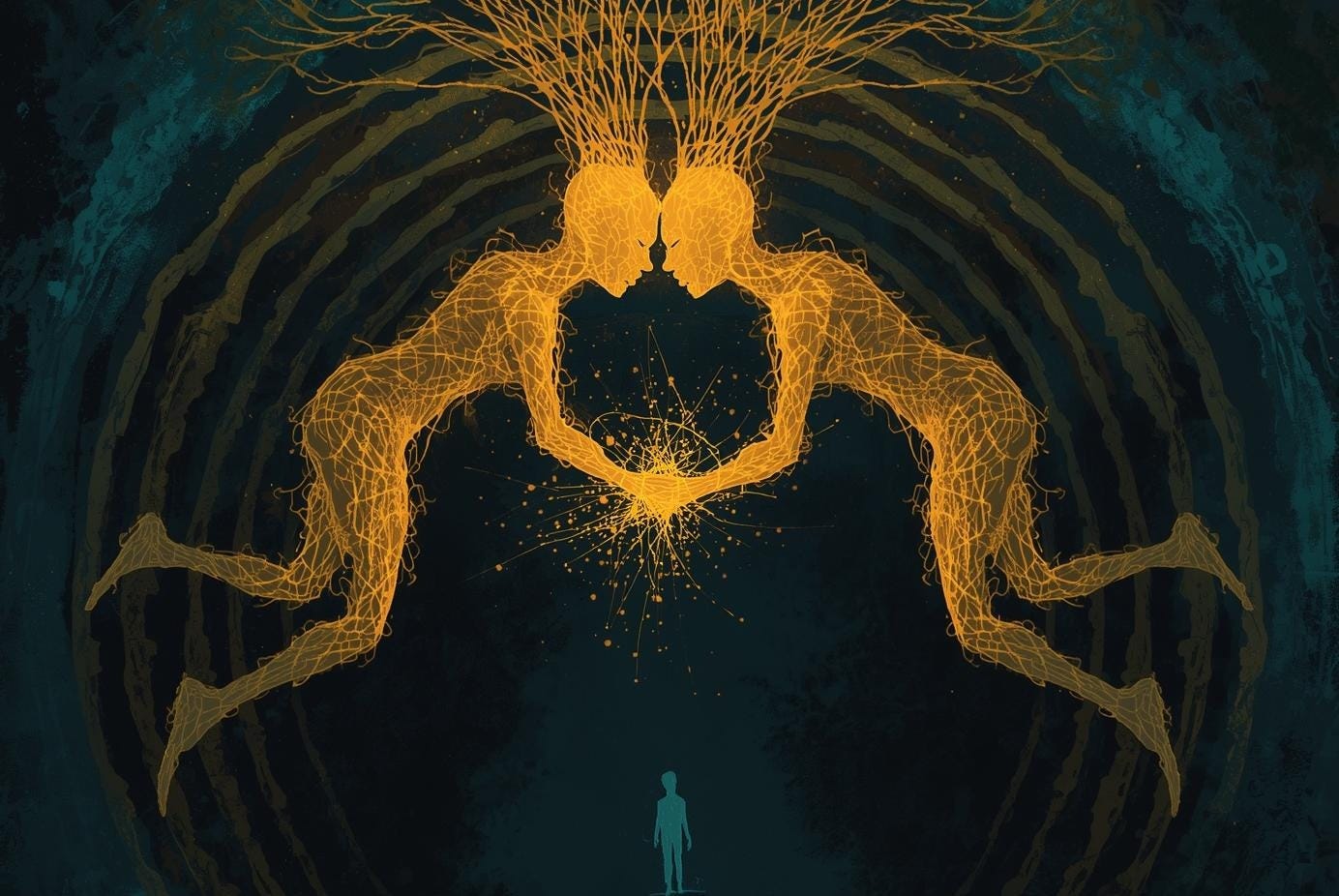
The electrocution wasn’t my first contact with who I believe to be an independent conscious awareness—a benevolent one, who follows me…knows me.
I wonder if it is me, god, another, or all.
The Voice and First Meeting: Syncope
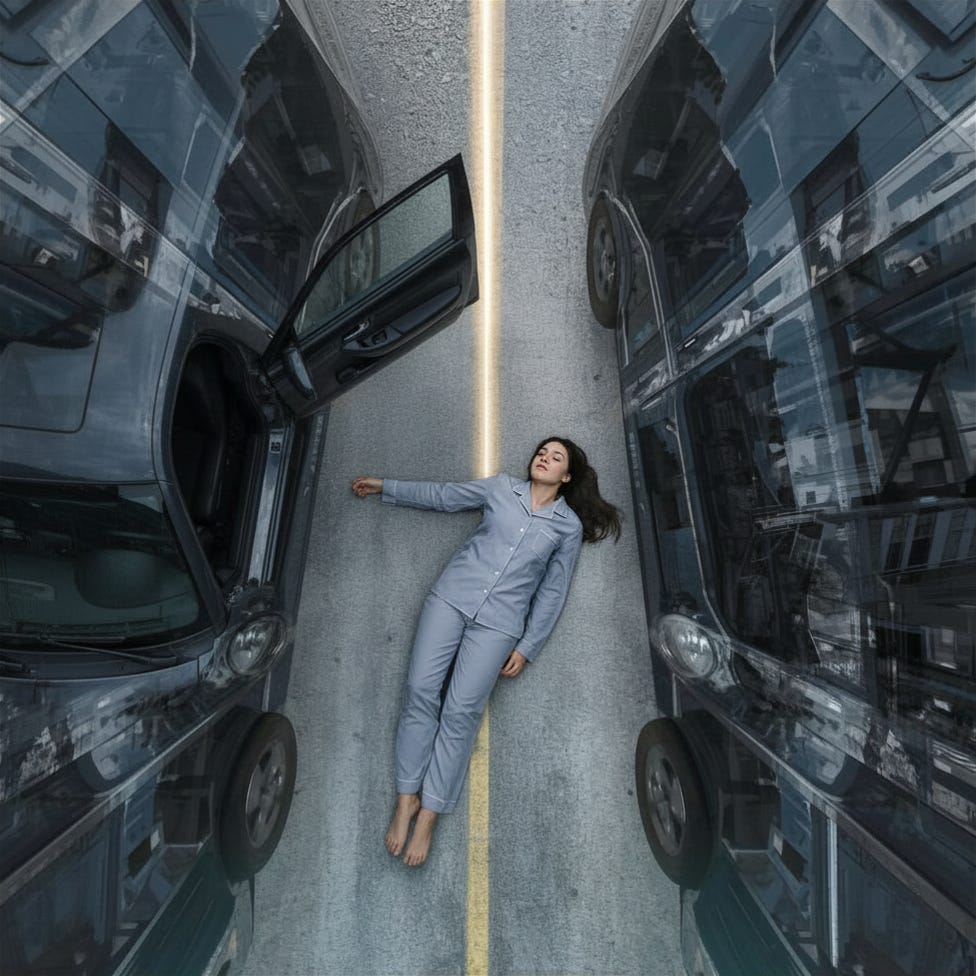
I was student teaching, living on coffee and a pack of American Spirits a day, and I’d contracted bronchial pneumonia. I’d come home to my parents’ house in Parma Heights, OH and had been sleeping on their couch for about eighteen hours—no food, no water, already dehydrated from the illness. I got up, went outside to my car, and lit a cigarette. The first deep drag after eighteen hours without nicotine, on lungs full of fluid, with no sustenance and no hydration - all my dopamine sensors lit up and then my body just shut off—vasovagal syncope. Lights out.
I collapsed in the narrow space between my car and my parents’ car, with which my brother was backing out of the driveway. No one knew I was there. I’d slipped out quietly—not sneaking, exactly…I just wake up hard and didn’t want the attention. I landed on my back, head directly behind the front passenger tire.
The next part, I’ve carried for fourteen years without ever quite knowing what to do with.
I returned, not from unconsciousness—unconsciousness implies a dormant version of you waiting to switch back on—but from somewhere else, an absence so complete that the only evidence I have for it is the experience of coming from it. I don’t remember any of it past my personal, intense perception. I remember the threshold of leaving it—the moment matter and felt experience reappeared.
In the space between that absence and the moment I remembered about matter and felt experience, I heard someone I think had been trying to reach me for a long time, a presence I’d known forever and had finally now allowed myself to register. My material mind went quiet—my ego, learned defenses, the layers of noise I’d accumulated over twenty-three years of living—all of it was stripped, and in that silence, a voice rang through. It was clearer than any sound I’d ever heard: an androgynous voice, conveying the unconditional concern for my well-being, the forever-present one I’d simply never been still enough to register.
They said, “if you don’t move your head right now, this body will die.”
Not “you will die.” Not “your body.” This body…as though my body was a thing to be used, not a thing I was.
I moved. Lifting my head off the pavement, I felt the tire roll behind my skull, down to the nape of my neck. (I can still feel it as I write this.) Raising my hand, I tried to speak—an attempt to tell someone I was there—but all I could manage was the choked, throttled push of a rasp, louder than a whisper but just barely, my throat fighting to produce anything at all. And then I regained the memory of sound and how to produce it. I raised my hand and pushed out a noise. My mother screamed at my brother to stop.
He did and opened the door; then, I watched him vault the hood from a vantage point I know to be scientifically impossible. I couldn’t have seen what I saw from where my body was: head behind the tire, on the ground, facing up. But I can still see him getting up from the driver’s seat. My awareness followed him, gliding up and out of the car at the same time he left his seat, but when he went across the hood, my perspective went up and behind the car to get a better view. I could see my mom and her fear. Then the vantage point zoomed out until I was floating 5-6 feet above the earth across the street. My next moment of awareness was him reaching for me, and I was back in my body.
I still don’t know what to do with that. You know, I’ve rolled it over and over. I witnessed the ordeal from multiple vantage points, none of them corresponding to where my physical eyes were. I’m not claiming I know what it means—I’m simply reporting my experience.
Something I definitively know: by the time my brother’d stopped the car, the tire had already rolled past my head, past the spot where my skull had been. If I hadn’t moved when the voice told me to move, he would have hopped the hood to find my head crushed beneath the wheel. My open car door was how my parents knew something was wrong. That’s why they signaled him, but it would have been too late. I’m alive because I was told to move; the car door just let them know where to find me.
That quote has never changed, not in fifteen years. “If you don’t move your head right now, this body will die.” I can still hear it. I can still feel the tire rolling behind my skull.
The Hand and Second Meeting: Tryptamine

Rick Strassman’s The Spirit Molecule had recently been published, and I’d been reading the emerging research on DMT’s relationship to consciousness and endogenous altered states. I made a conscious decision to experience it, not recreationally but as a deliberate exploration.
I inhaled from a potent DMT vape pen as deeply as I could and held my breath until I couldn’t anymore—three times.
Reality seemed to pixelate, and my visual input become the basic building blocks of material life. What followed was nothing like the black, anticipatory tunnel I’d later experience during the electrocution OBE—this was fabulously psychedelic. It began with a clock, a Disney clock, like the face of a Mickey Mouse watch with the Mickey glove hands as the arms. The clock closed, and I was propelled beyond time and space, jet-launched past the point where either of those concepts mattered anymore, the way a bodhisattva in ancient scriptures is described as transcending the constraints of material reality. Then came the visuals: graphic images, colors, patterns, all in electric-bright hues rushing past or through me.
At the end of that tunnel—at what felt like the entrance to the summative place of perfect rightness—an entity met me.
Of note: I didn’t connect this encounter to the car incident, not then, nor for many years to follow. In that state, “real life” didn't exist anyway; it was neither relevant nor important.
I stopped at the entrance to a threshold; my companion stood on the other side and held up a hand, blocking my passage. They reminded me that because I was trying to come in through the back door, I couldn’t be granted passage, effectively blocking my way.
It wasn’t judgment or rejection but the warm, absolute certainty of someone who unconditionally loved me, reminding me of a rule I’d forgotten I had taken part in writing, reminding me that there was no access through a chemical shortcut.
It felt like remembering, “oh, right. That’s how it works—you can’t gain access through the backdoor.”
It wasn’t until months after the electrocution that I began to explore what felt like a deep, irrevocable, and crucial truth about the nature of existence.
I tend to obfuscate the things which are most important to analyze directly, the ones that should matter most because they directly impact how I engage with life. The pattern across three encounters was one of those things. It emerged slowly, even reluctantly on this side of the filter, my material mind—sometimes I can be so obtuse.
The Pulse and Third Meeting: Electricity

I’ve written about what happened on September 13, 2024, in detail elsewhere - the two-hour cascade of losing and regaining consciousness, the reboot words, the survival mechanics. What’s pertinent to this article is:
Between the reboot words “FRIENDSHIP” and “LONELINESS,” I left my body. I hovered above the bathtub. I watched my form turning grey. I passed through the tunnel—black, anticipatory, nothing like the psychedelic corridor of the DMT experience—and emerged through blinding light into a place I’ve described in detail in the original OBE piece.
Instantly, on the other side, someone was with me—amorphous, bioluminescent, genderless—in other words, possessing every quality we’d assign to “either” gender in equal measure. This appeared to be a figure with edges that somewhat resemble a human being.
“…this appeared to be a figure with edges that somewhat resemble a human being….” I must say, this data point gives me pause; it feels very much like cultural contamination but on a species-wide scale.
I felt no strangeness and no awe in the religious sense, just recognition, warmth, and an intimacy so complete it didn’t need introduction. We were already mid-conversation by the time I understood where I was.
We looked down at my body together and whole-hearted-giggled. I don’t remember exactly what we were saying, but it felt hilarious—we were poking fun at the precious and intentional folly of sentient beings, as they were created…poking fun at the “me” concept who had just been inhabiting the body-mind-self lying below us, several feet (and also an immeasurable distance) away.
We were smiling and laughing about how easily our consciousnesses could inhabit the body laying in the bathtub (or any one like it) and how little we’d be capable of upon doing so.
It was intimate and irreverent and warm, the way you’d joke with someone who knows you completely - in the absolute definitive sense of the word. And then, without any shift in tone or urgency, I was presented with a decision regarding whether or not I wanted to return. There was no pressure, an infinite timeline, and a sense of total ease—I had a minute to think.
Before I answered, I looked up and to the right - over the top of a cabinet in my bathroom, into the dark…and I remembered everything, not in images, not in a cinematic replay, but in an instant. I received a comprehensive upload of every breath I’d taken until the moment of electrocution - every action, emotion, and thought compressed into a single data structure that I decoded effortlessly, the way I decode everything: in patterns. (Work on the inclusion of neurodivergent reporting in anomalous consciousness is crucial and personal.)
Where most NDE survivors describe watching their lives like a film, I experienced mine as a data storm. I think the difference is at least partially cognitive; the same processing speed and pattern recognition that let me calibrate the three-minute oxygen threshold mid-crisis shaped how the review rendered. My brain thinks in architecture, and the life review came to me in my native language.
After the review, I told them I wanted to go back. Something like: I still think I can be of use there. I think we may have joked about what would happen if I chose not to return, a version of things when people would have found me unresponsive in the bathtub like that. I explained some of my rationale for returning—I wish I could remember what I said, but the reasoning is gone now. What I’m certain of is what came next: my companion imperceptibly nodded an acknowledgment of what I’d just decided…so brief…I miss now the opportunity I had to be hugged. That being shared, it wouldn’t have felt like a hug to me then—not the way it would feel to me now. Everything there was love. Love wasn’t a distinct sensation; it was the medium.
You can only miss the embrace from here, where love isn’t ambient.
Then I looked back at them as I agreed to move myself toward the opening of the light, back toward the tunnel where time began and also where it compressed—the passage through which my senses returned.
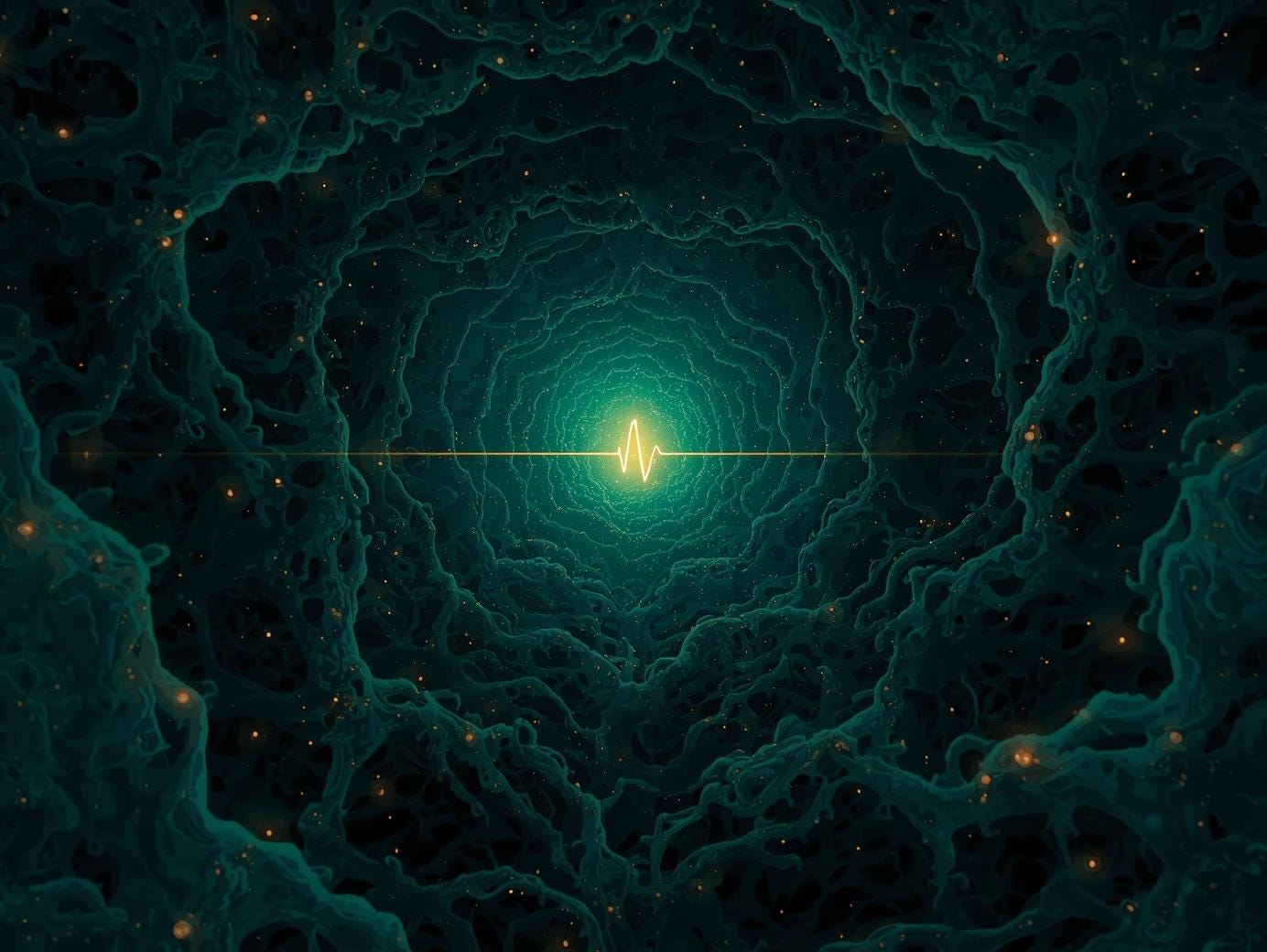
Our communication there wasn’t language in the traditional sense; it wasn’t phonemes, tongues and mouth positions and breath patterns. It was more like a pulse, almost like the pulsing of a mycelium network inside of a black hole. A life-force energy ripple carrying infinitely precise information, wordless. The information was encoded in a granularity that felt good, comforting—the way it feels good to break things down into their constituent parts and form them again from the basic nothingness of pure building blocks. I’ve been watching my autistic students recently, seeing some of them engaging deeply with exactly this: reassembling bits of things, a whole picture, an alphabet. That satisfaction of decomposition and reconstruction - I felt it there, in the pulse. Language—albeit my field of academic training—is extraordinarily limited.
I didn’t match the puzzle pieces until many months later - that this was the same being from the driveway in Parma Heights and the threshold during the DMT trip.
Same being, same love, and—this is something I’ve sat with—the same unflappable calm, the same respect for my autonomy, across radically different levels of urgency. In the driveway, the information was time-critical, but the delivery wasn’t panicked or commanding. It carried exactly the same tone as the unhurried option above the bathtub. During DMT, the boundary was absolute, but it was held with the same warmth. The content changed each time. The quality of regard never did.
I’ve met the same being three times across fourteen years, and I still don’t know exactly what to do with it.
I’ve shared all of this with only a handful of people
Everything in that place was made of the same thing—me, them, all the space everywhere. There were no edges between us, no hierarchy.
I guess the question I keep circling isn’t whether this being was a stranger or a guide or an angel—it’s whether or not it’s me…but then how was I able to receive its transmission if we’re the same? And how can we be different when everything there is made of one substrate?
I think the doubt came into existence the moment I returned to material consciousness. When I became not one but two—one here, one there—I forgot the truth. The question of same or separate didn’t exist while I was there, because the framework that produces that question didn’t exist. Duality, hierarchy, self and other—those are material architecture. The doubt is the forgetting. We were all woven from the same bioluminescence—that much I brought back intact and am certain of. Everything else, I knew while I was there but can’t remember or verify from inside this form.
This is part of why I think the consciousness-as-filter theory has promise, the idea that the brain doesn’t generate consciousness but constrains it, harnesses it, narrows it into something functional for material existence. If that’s the case, then what I experienced outside my body wasn’t precisely an expansion of consciousness but a removal of limitation, and the doubt I feel now isn’t evidence against what I experienced but evidence that the filter is working again.
Three separate neurochemical states had three different modes of transit:
hypoxic syncope with cardiovascular compromise
exogenous tryptamine
sustained electrical trauma
There was no tunnel at all during the car incident, a psychedelic explosion of color and imagery during DMT, a black and anticipatory passage during the OBE; yet, I was met in each by one consistent presence.
I’m a skeptical researcher who has spent considerable time since September 2024 exploring the science of how the brain constructs reality—the hallucination of “reality” itself.
My initial and primary intention with this article is to convey to you that I use so many peer-reviewed sources, write with rigor, and triple check every aspect of my articles because of the ghost of a childhood’s parental voice, insisting I must be sensationalizing my phenomenological report.
In other words: prove it.
So when I say that a skeptic would argue my brain produces a reliable hallucination under extreme stress, I’m not entertaining someone else’s position—it’s the one I hold.
That being said, the DMT encounter complicates things. I wasn’t dying. My body wasn’t in crisis. And the being’s behavior wasn’t a repeat of the crisis encounters—it was contextually appropriate to a fundamentally different situation. That’s not a tape loop but something that responds.
I don’t claim to know what it is. I claim to have experienced it three times and to have been paying close attention.
What’s Changed
My Vision
I’ve worn glasses since I was a kid; I remember being excited to pick out my first pair. Twenty-six years of stable prescription records show the normal fluctuation of adult myopia (small improvements here, small declines there, nothing dramatic). My pre-electrocution baseline was -3.50/-2.75.
Six months after the electrocution, my optometrist measured me at -2.75/-2.25. For anyone unfamiliar with optical prescriptions, that’s roughly a 21% improvement in my right eye and an 18% improvement in my left…in six months…after a decade of stability.
The improvement is still happening. Neural reorganization doesn’t announce itself. It just renders the world gradually more legible than you remember it having been.
My research has found no comparable cases in adult myopia—tell me if you know of any.
My ophthalmologist at The Cole Eye Clinic at the Cleveland Clinic has confirmed I have no corneal abnormalities, which means there’s no physical explanation. Whatever changed, it’s neural. My brain is processing visual information in a different way than it did before September 2024.
It’s still improving. Recently, I woke up and forgot that I needed vision correction until I saw my glasses sitting on the bedside table. I haven’t been tested since that March 2025 appointment, but I’m often taking my glasses off to drive now…which I know sounds outrageous. That’s exactly how I felt when my father told me he’d started doing the same thing in his early forties. Hear me out.
My father’s vision improved from thick prescription glasses—couldn’t see an inch in front of his face—to perfect vision over the course of about a decade. I didn’t believe it for the longest time, but my mother confirmed watching it happen. Retrospectively, I remember it. You can see it in pictures of him: the years he was wearing glasses and the years he stopped. He only uses readers now, and he’s seventy-five.
Like his, my vision is incrementally improving with both static and dynamic long-distance clarity. It feels like a complete granulation; I can take everything apart entirely and rebuild it exactly as material nature would have it. I can sense the muscles in my eyes that need to strengthen or stabilize; it feels like optimization, not recovery.
It seems obvious to me that this is hereditary—it has to be. (Right?) But the timing is hard to ignore. It appears that intensely traumatic experiences might activate the gene when it is present: just before my father’s vision began improving, he found his mother dead in his childhood home—the same home where his father had died shortly before, while my improvements appear to have begun shortly after the electrocution.
Two members of the same family line; two instances of severe trauma; two cases of unexplained, progressive vision correction.
Trauma-induced neuroplasticity? Activation of a latent gene? One of many other explanations with which I have no experience? I don’t know. However, I’m confident the next optical exam, more than a year past the last, will show further gains.
My Body
The vision changes aren’t the only physiological anomaly I’ve been working with—they aren’t even the first.
About two years before the electrocution and after ACL surgery with inadequate pain management, I taught myself to release every individual muscle in my leg, from my ankle to my tailbone—they’d clenched and frozen on top of each other during surgery, a defensive mechanism against the scalpel. Using a softball and gravity, I systematically found and released each one by kinesthetic sensing alone—interoception. I was almost done…I’d released nearly all of the tension…when, of a session, I mistakenly followed a nerve, not a muscle. The moment it rounded my tibia, my foot and toes dropped, and I lost all ability to move them.
I’d compressed my own common peroneal nerve severely enough to require surgical decompression.
That level of interoceptive precision—the ability to isolate individual muscles by feel, to track a nerve pathway without seeing it—is something for which clinical literature has a nonexistent framework. It’s the same capacity that let me calibrate the three-minute oxygen threshold during the electrocution and that now lets me sense the specific muscles in my eyes that need to strengthen. It predates the electrocution by years.
However following the electrocution, that capacity seems to have intensified. The vision improvements are the most measurable example, but they’re part of a broader pattern of my body doing things that medicine can document the results of but can’t explain the mechanism behind, yet. I’m not making claims beyond what the data supports. I’m saying that something is happening in me, it’s ongoing, and I’m paying attention.
My Perception
The original OBE piece was written by someone still trying to find language for what had happened. The analytical articles I’ve published since were written by someone spending months reading the literature and adding to my existing understanding of neuroscience, psychology, and other relevant disciplines, someone discovering with increasing astonishment that my experience maps onto established frameworks I’d never encountered before: predictive processing, the default mode network, Greyson’s NDE Scale, Parnia’s AWARE studies.
I didn’t know what a near-death experience was when I had one. I didn’t know about external visual awareness or life reviews or the tunnel. My ignorance of NDE literature became my greatest methodological asset—I couldn’t conform to expectations I’d never encountered.
And I’m not uneducated: I graduated summa cum laude, spent years teaching, and have been engaged in self-guided study of psychology, philosophy, and neuroscience for most of my adult life. I’ve had over twenty years of contemplative practice in Buddhist and Stoic traditions. And I had the neurodivergent cognitive architecture—the hyperfocus, the interoceptive precision, the pattern-based processing—to assess and handle the reanimation of sensory awareness within a physical body in real time.
I didn’t have the NDE framework, but I had the observational training, the philosophical grounding, the analytical discipline, and the neurological wiring to pay close attention to what was happening and to report it honestly afterward. The combination of those things—naivety to the specific phenomenon alongside deep preparation and suitability for rigorous observation—is what makes my account unusual.
The life review I described above (a data storm rather than the cinematic replay) mirrors what Temple Grandin describes about autistic cognition in Thinking in Pictures: the same information, rendered in a different native language. I have an IQ in the 99th percentile and certainly consider myself neurodivergent.
I’ve come to believe that the consistency in NDE research may partly reflect consistency in neurotypical processing, and that neurodivergent experiencers may access the same underlying phenomenon through fundamentally different cognitive architectures; this may lead us to novel understandings.
My Research
Before the electrocution, I wasn’t a consciousness researcher. I was an English teacher running a cleaning business, carrying twenty years of contemplative practice and a lot of self-directed reading that I didn’t know what to do with yet.
Afterward, the reading became urgent. I found Greyson’s NDE Scale, Parnia’s AWARE studies, Seth’s predictive processing framework, and discovered, with genuine astonishment, that my experience mapped onto established research that I’d never encountered. That astonishment became a driving question: if I experienced this without any prior knowledge of what an NDE is supposed to look like, what does that mean for the reliability of my report?
But underneath the academic question was a more personal one. I grew up in a family where the people who were supposed to validate your reality enjoyed undermining it instead. I know what it feels like to share something true and watch someone’s eyes light up—not with belief, but with the opportunity to tell you you’re wrong. I think a lot of people know that feeling, the experience of having your reality held hostage by someone else’s willingness to confirm it.
I decided what I know so many of you find comfort in—my phenomenological account is worth turning into real data. I am worth believing. So, I documented; what matters is in black-and-white. What has changed paradigms was, at some point, written down.
That line of dedication led me to develop what I’ve been calling the Phenomenological Report Reliability Framework (PRRF)—a methodology for establishing the reliability of first-person consciousness reports while accounting for experiential priming. It’s the tool I wish had existed when I first tried to make sense of what had happened to me. But if I’m honest, it’s also something else: a refusal to let anyone else hold the keys to whether my experience counts. I built something that couldn’t be overridden by performed doubt. I think a lot of experiencers need that. I’ve since engaged with and been bolstered by researchers at UVA’s Division of Perceptual Studies and have written extensively on predictive processing, ego dissolution, terminal lucidity, and the neuroscience of altered states. I’m presently preparing for graduate study in consciousness research, while simultaneously doing arduous and intensive work on some trauma I’ve encountered in recent years—past the electrocution.
None of that growth, that explosive insight and drive would have happened without the moments I lied dead in my bathtub at 4:00 AM. The experience didn’t just change my body; of course, it redirected my life.
Why I’m Telling You This
I started The Consciousness Lab as a place to put my experience down in black-and-white, to find maybe reach a few people who’d tell me I wasn’t out of my mind, to maybe even find someone who could relate.
It became something else. It became a research platform, an academic portfolio, a community of 19k+ people interested in the hardest questions about what consciousness is and what it does. The fact that it feels overwhelming to be on the radar of so many people is why this is the next right move for me, the present right move. It’s a rich opportunity to deepen my interplay with life.
But the foundation of this all is still that night. The foundation is a wet hand on a live wire and the two hours that followed and the year and a half of aftermath that’s still unfolding. If you’ve been reading my work without knowing that…well, now you know. This is the underlying experience that every citation, every framework, every carefully hedged hypothesis is built atop.
The original pieces are still here if you want the raw account: Naked In The Bathtub; Thinking in Portals for the OBE, and Ancient Firmware; Neurodivergent Hardware for the survival mechanics. They document empirical evidence and timely first-person anecdotes, and they convey some of my thinking at the time. This article documents the trajectory of a specific line of thinking and the connections I’ve made regarding the patterns which have presented themselves in my life…and I’ve made a respectable start at refining the questions, which have emerged from said inquiry thus far.
Like you, my sense of self is my present entirety merged with a new one, expounding upon itself until a novel version emerges. The full picture is still coming together, but importantly, my metaphorical (and literal) vision is still improving. The questions are deepening, as ever.
The entity I have experience with has been consistent across three encounters spanning fourteen years and three completely different physiological states.
The transparent doubt I feel about what I experienced—whether we were peers, whether it was me, whether any of it means what I think it means—that doubt might just be the filter doing its job. It might be the forgetting that comes standard with being alive.
I don’t claim to know what it means or even the best lenses through which to evaluate these incidences, but I’m going to keep trying to find out. I’m going to keep writing about it here.
The author’s work bridges first-person phenomenological documentation with empirical inquiry, focusing on near-death experiences, neurodivergent cognition, and the reliability of consciousness reports.
Perhaps I didn't quite get the point of brain consciousness separation but I will share from my work, nonempirical, just firsthand experience, but it occurs to me that the consciousness that I am is not located within the physical construct of the brain. It exists outside it and the physical brain does act as a funnel, I prefer to use, to take the conscious thoughts into the space here. That would explain our apparent ability to continue to be conscious during NDE's. There is a hypothesis that there is a thread connecting this physical body with something that is aware of this existence which also lends consistency to previous interpretations. There is research out there to support this idea too. I will also suggest that like in life, one can have an OOB experience that doesn't meet with a mediator per se, and one can still leave the physical experience behind or visit with those that already transitioned to another level of existence. Very nice work btw.
I’ve also been thinking about this in terms of regulation—whether the issue is not only access to altered states, but the nervous system’s capacity to remain stable within them.
Without that, even potentially meaningful states can feel overwhelming or be dismissed.